Commercial Hardwood Floor Refinishing in London | Sanding Wood Floors
London’s commercial properties — from the Victorian-era board rooms of the City to the parquet-floored halls of Hackney community centres, the sprung maple gymnasiums of Islington secondary schools, and the oak-strip dining rooms of Chelsea restaurants — carry an enormous amount of hardwood underfoot. These floors were built to last. But without proper attention, years of heavy footfall, trolley drag, chair scraping, and neglected maintenance gradually reduce them to a dull, abraded, or even hazardous surface that lets the entire building down.
If you manage a commercial property in London and you’re looking at a floor that’s lost its finish, developed deep scratches, lifted boards, or simply looks tired and uninviting, professional commercial hardwood floor refinishing in London is almost certainly the most cost-effective solution available to you — far cheaper than full replacement, and with results that can genuinely transform how a space feels and functions.
At Sanding Wood Floors, we have been restoring and refinishing commercial hardwood floors across London for over 30 years. We work with property managers, school bursars, church wardens, hotel facilities teams, retail operators, office managers, and building owners throughout every London borough — from the well-worn sports hall floors of Southwark to the grand ballroom parquet of Kensington.

What Is Commercial Hardwood Floor Refinishing?
Refinishing a hardwood floor in a commercial context is the process of mechanically removing the old, worn finish layer — along with surface scratches, staining, and contamination — right down to clean, fresh timber, and then reapplying a durable, appropriate coating suited to the demands of the space.
It is a fundamentally different undertaking from domestic floor sanding. Commercial floors are typically larger, subject to heavier and more varied wear patterns, and the logistics of the work — access, timing, dust management, drying times, and occupant disruption — require far more careful planning. A sports hall cannot simply be closed for a week without advance coordination. A hotel lobby cannot be filled with sanding dust at 11 o’clock on a Tuesday morning.
This is precisely why it matters who you appoint for the job. Experienced commercial floor sanding contractors understand not just the technical side of the work, but the operational realities of working in occupied or semi-occupied premises.

Why London Commercial Floors Need Specialist Attention
London’s commercial and institutional buildings present a distinctive set of challenges for hardwood floor restoration. Many of the city’s schools, churches, town halls, and office buildings were constructed in the late Victorian or Edwardian period, with original softwood or hardwood board floors that are now well over a century old. Others were fitted with block parquet or maple strip flooring in the mid-twentieth century — materials that, whilst durable, respond poorly to amateur sanding or the wrong choice of finish.
The sheer density of London’s built environment also creates logistical challenges that simply don’t arise elsewhere. Access constraints, nearby residents and businesses, parking restrictions, early-morning delivery windows, and the need to work around the schedules of tenants, pupils, or congregation members all require a contractor who can plan and communicate effectively.
The good news is that most commercial hardwood floors in London — even those in very poor condition — are restorable. The timber itself is often sound; it is only the surface coating, accumulated dirt, and minor damage that needs addressing.
Step 1 — Initial Assessment and Condition Survey
Good refinishing work begins long before a sanding machine appears on site. The first step is always a thorough assessment of the floor’s condition, the type of timber, the existing finish, and the practical constraints of the premises.
During our survey, we check for:
Timber species and board thickness. Knowing whether you have solid oak, ash, maple, pine, or an engineered hardwood is critical — different species respond differently to sanding and finishing. Board thickness determines how many times a floor can be safely sanded in its lifetime.
Existing finish and contamination. Old polyurethane lacquers, black bitumen adhesives (common under lifted parquet), wax contamination, or silicone-based products all affect how we approach preparation. Some coatings need chemical stripping before mechanical sanding; others need careful removal by hand around edges and doorways.
Structural issues. We look for loose, cupped, split, or springy boards; protruding nails; board gaps; evidence of moisture ingress or subfloor movement. These must be addressed before sanding begins, not discovered halfway through.
Safety considerations. In commercial premises, we assess whether any areas of the floor pose a trip or slip hazard that needs urgent remediation, particularly near staircases, transitions, or high-footfall routes.
For most London commercial projects, we recommend a site visit before quoting. For smaller areas or where good-quality photos and measurements are provided, we can often give a reliable indicative price remotely — simply send images and a rough floor plan via WhatsApp or email.

Step 2 — Repairs, Board Replacement, and Gap Filling
A refinishing project is only as good as the floor it starts from. Sanding over a floor with structural problems simply reveals those problems more clearly; it does not fix them. This is why our wood floor repairs phase is treated as essential, not optional.
Board Repairs and Replacement
In commercial premises, individual boards are often damaged by water leaks, heavy furniture, or years of mechanical wear. Loose boards need to be re-secured — either by blind-nailing through the tongue or by surface-nailing and counter-sinking. Badly split, rotten, or structurally compromised boards need replacement. Where possible, we source matching timber to minimise visible contrast, though in heritage buildings some variation in new replacement boards is unavoidable and, in most cases, entirely acceptable.
Parquet Re-Bedding
Old parquet flooring restoration is a specialism in its own right. In schools, churches, and community halls across London, we regularly encounter block parquet floors where a significant percentage of blocks have lifted, cracked, or become hollow-sounding. These must be carefully removed, the subfloor cleaned of old bitumen adhesive, and the blocks re-laid and re-bedded before the floor can be sanded. Attempting to sand over loose or hollow parquet simply damages both the machine and the floor.
Gap Filling
Board-to-board gaps are extremely common in older London commercial properties, particularly where central heating has dried out the timber over decades. Small gaps between boards are normal and can be left; larger gaps, particularly those wide enough to trap debris or create a trip risk, should be filled. We use two principal methods:
Gap filling with resin — a flexible two-part compound mixed with the timber dust produced during sanding, giving a highly natural colour match. This is ideal for wider, irregular gaps.
Gap filling with strips — solid timber or cork strips cut to fit, glued in place, and sanded flush. Better suited to very wide or uniform gaps where a more structural fill is needed.

Step 3 — Dust-Controlled Sanding and Surface Preparation
This is the stage most people picture when they think of floor refinishing — and it is where significant differences in quality and professionalism become apparent.
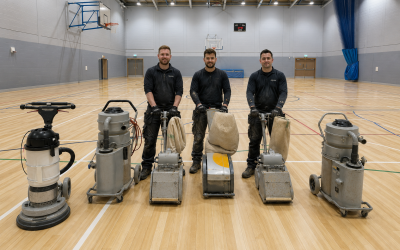
We use dust-free floor sanding equipment throughout all our commercial projects. Our Bona and Lagler machines are fitted with high-filtration dust bags and connected to industrial vacuum extraction units, capturing the vast majority of sanding dust at source. This is not just a matter of tidiness — in a school, a hospital, a food-service environment, or a heritage building, airborne fine wood dust is a genuine health hazard and a source of serious disruption. Our dust-controlled approach means that in many cases, adjacent rooms or areas can remain in use during the work.
The Sanding Process
We work through a sequence of abrasive grades, starting coarser to remove the old finish and level any surface irregularities, and moving progressively finer to achieve a smooth, clean surface ready for finishing. The number of passes required depends on the timber species, the thickness and condition of the old coating, and the desired final texture.
Edges and corners — the areas a drum sander cannot reach — are finished by hand or with a small orbital edge sander, taking care to blend with the main floor surface. Stair nosings, thresholds, and awkward areas around radiator pipes or fixed furniture are addressed individually.
If the floor has suffered significant staining — from water marks, chemical spills, or old cleaning products — we assess whether sanding alone will remove it or whether localised chemical treatment is needed before sanding.

Step 4 — Finishing Options: Lacquer, Oil, Hardwax Oil, and 2K Finishes
The choice of finish is arguably the most important decision in any commercial refinishing project. The wrong finish — or a domestic-grade product applied to a high-traffic commercial floor — will deteriorate rapidly, leading to costly re-treatment within months. Our recommendations are always based on the specific use of the space, the expected footfall, and the client’s maintenance preferences.
Water-Based Lacquer
For most commercial interiors — offices, retail spaces, hotel corridors, entrance halls — a professional-grade water-based lacquer from manufacturers such as Bona or Loba provides an excellent balance of durability, clarity, and ease of maintenance. Applied in two or three coats, with a light flat-screen between each, a quality water-based lacquer cures hard within 24 to 48 hours and resists scuffing, abrasion, and most everyday cleaning chemicals.
We never use cheap trade lacquers from general builders’ merchants. Professional-grade products formulated specifically for commercial timber floors offer significantly better performance and longer intervals between re-treatment.
2K (Two-Component) Lacquer
For environments with exceptionally heavy footfall — sports halls, gym floors, dance studios, school dining rooms — a two-component (2K) catalysed lacquer offers the highest level of abrasion resistance available in a surface coating. Products from Junckers and similar specialist suppliers are specifically formulated for sports and high-traffic commercial applications, and will typically outlast single-component lacquers by a considerable margin.
Hardwax Oil
Wood floor oiling with a professional-grade hardwax oil — products such as Osmo Polyx-Oil or Bona’s commercial oil range — is an increasingly popular choice for commercial spaces where a more natural, matte appearance is preferred. Hardwax oils penetrate into the timber rather than forming a surface film, giving a warmer, less plastic appearance and making localised repairs and maintenance considerably easier. Rather than having to resand and refinish an entire floor to address wear in high-traffic zones, an oiled floor can often be spot-treated or screen-buffed and re-oiled in affected areas.
Oil vs Lacquer: Which Is Right for Your Premises?
This depends on several factors: the species of timber, the pattern of use, the availability of trained cleaning staff, and your maintenance budget. We are happy to discuss this in detail during our survey — the right answer is not always the most obvious one, and we prefer to give genuine advice rather than default to whichever product is easiest to apply.

Step 5 — Aftercare and Ongoing Maintenance Planning
A well-refinished commercial hardwood floor should last many years before it needs full sanding again — provided it receives appropriate commercial hardwood floor maintenance in London. The single biggest factor in extending the life of a commercial floor finish is the daily and weekly cleaning regime.
We provide all our commercial clients with a clear written aftercare guide covering:
- Appropriate cleaning products and dilution rates (wrong products destroy lacquer and oil finishes surprisingly quickly)
- Entrance matting and furniture protection recommendations
- Signs of wear to look for and act on early
- When to book an intermediate maintenance buff-and-coat rather than waiting for a full sand
Catching a floor at the stage where it needs a maintenance buff — rather than a full sand — can save thousands of pounds. A wood floor buffing and re-coat typically takes one or two days for a medium-sized commercial space, causes minimal disruption, and extends the life of the floor by several years.
We also offer scheduled floor maintenance services for clients who prefer a planned maintenance programme — particularly useful for schools, multi-site businesses, and organisations managing listed or heritage buildings where the floor has significant intrinsic value.

Commercial Sectors We Serve in London
We undertake commercial hardwood floor restoration in London across a wide range of commercial and institutional settings. Below is a summary of the principal sectors we work in and the specific considerations involved.
Schools and Educational Buildings
School floors are among the most demanding environments we work in. A primary school hall floor may see 400 children crossing it every day; a secondary school sports hall endures court sports, PE lessons, and assembly events throughout the academic year. We work as a commercial hardwood floor sanding contractor in London with local authority schools, independent schools, and academy trusts throughout London, typically scheduling major works during half-term breaks, Easter holidays, or the summer. We understand the logistical constraints of working within Ofsted-registered premises, and our dust-controlled processes minimise any risk to pupils or staff. See our dedicated school floor sanding service for further detail.

Offices and Corporate Premises
Office floors in London range from Victorian board floors in converted Georgian terraces to wide-plank engineered hardwood in modern fit-outs. Both require care and expertise. We can work overnight, at weekends, or in phased sections to avoid disruption to your business operations — moving furniture, sectioning off areas, and restoring the floor in rotation so that you never lose the entire floor space at once.

Hotels and Hospitality
Hotel lobbies, restaurant dining rooms, bar areas, and function suites all benefit enormously from well-maintained hardwood floors. In the competitive London hospitality market, the condition and appearance of your floors sends a powerful signal to guests. We have extensive experience working within hotel properties, including coordinating with facilities managers, FOH teams, and overnight access constraints. Our dust-controlled processes are particularly important in food-service environments.

Churches and Places of Worship
Many of London’s churches — from the great Victorian Gothic revivals of North London to the Wren-era City churches and the post-war community churches of the outer boroughs — have original timber floors of significant heritage value. We treat these floors with the respect they deserve, recommending finishes appropriate to their age and character. Scheduling is always coordinated around services, events, and community use.

Community Centres and Halls
The community centre floor sanding work we undertake across London often involves floors that have had decades of varied use — from fitness classes and children’s parties to polling stations and council meetings. These floors are typically resilient but in need of serious restoration, and the budgetary and logistical constraints of community organisations require a contractor who can plan and price honestly.

Retail and Showrooms
Retail floor refinishing in London requires particular sensitivity to the visual outcome. Whether you operate a boutique on King’s Road, a gallery in Shoreditch, or a furniture showroom in Fulham, the floor is part of your brand. We take the time to discuss finish options and colour with retail clients, and our work is carried out to a standard that stands up to close scrutiny.

Why Choose Sanding Wood Floors for Commercial Refinishing?
There are many floor sanding companies operating in London. Here is what sets us apart for commercial work specifically:
Over 30 years of experience. We have been refinishing commercial timber floors in London since the early 1990s. We have seen virtually every type of floor, every type of problem, and every type of commercial environment. That experience is not transferable — it is genuinely reflected in the quality of our assessments, our recommendations, and our finished work.
Dust-controlled machinery throughout. We invest in professional-grade equipment from Lagler, Bona, and other leading manufacturers. Our extraction systems meet the dust suppression requirements expected in commercial and institutional buildings, and our work leaves your premises clean.
Fully insured, NWFA-trained operators. All our sanding operatives have completed National Wood Flooring Association training and work to professional standards. We carry full public liability insurance appropriate for commercial premises.
Flexible scheduling. We work evenings, weekends, overnight, and during school holiday periods. We are experienced in phased working and can coordinate with your facilities management team or site manager to minimise disruption.
Professional product selection. We only use commercial-grade finishes from Bona, Loba, Osmo, Junckers, and other recognised professional manufacturers. We do not use domestic DIY-grade products on commercial floors.
Honest pricing. We provide clear, detailed written quotations. We do not add hidden costs or vary our price once work has started without first discussing any additional findings with you.
Frequently Asked Questions
1. How long does commercial hardwood floor refinishing take in London?
The duration depends on the floor area, its condition, and the finishing system chosen. A medium-sized office floor of around 200 sq m in reasonable condition could typically be completed — sanded, repaired, and coated — within three to five working days. Larger or more complex projects (such as a school hall with extensive parquet repairs) will take longer. We always provide a realistic programme as part of our quotation.
2. Can the work be done outside business hours to minimise disruption?
Yes. We regularly work overnight, at weekends, and during holiday periods for commercial clients in London. Water-based finishes have low odour and cure relatively quickly, which makes out-of-hours working particularly practical. We discuss scheduling requirements thoroughly before the project begins.
3. Is dust-free sanding genuinely dust-free?
No sanding process captures 100% of dust — any contractor who claims otherwise is overstating the case. What our dust-controlled system does is capture the vast majority of fine dust at source, to a degree that far exceeds the results of traditional sanding machines. In practice, our commercial clients consistently report that the work produces far less mess than they expected.
4. How often does a commercial hardwood floor need refinishing?
This depends heavily on footfall, the type of finish, and the quality of the daily maintenance regime. A well-maintained office floor with a quality lacquer might need a full sand every 8 to 12 years, with an intermediate buff-and-coat at the midpoint. A school sports hall will need more frequent attention. We can give you a realistic assessment during our survey.
5. What is the difference between a full sand and a maintenance buff?
A full sand involves mechanically removing the existing finish layer entirely and applying new coats — typically required when the finish has worn through in multiple areas or the floor has accumulated scratches that cannot be addressed otherwise. A maintenance buff involves lightly abrading the existing finish and applying a fresh top coat, which refreshes the appearance and extends the life of the floor. A buff is quicker, cheaper, and less disruptive — and is the right choice when the floor is caught early enough.
6. Can you work in a listed building or conservation area?
Yes. We have extensive experience working in listed properties and conservation areas across London. We use finishes appropriate to the age and character of heritage timber floors, and we can provide specification documentation if required by a conservation officer or landlord.
7. Do you provide a written quotation?
Always. We do not price work verbally and then vary it on site. Our written quotation sets out the scope of work, the materials to be used, the programme, and the total price. Any variations discovered during the works (such as additional board replacement) are discussed with you before we proceed.
8. How do I get a quote for my commercial premises?
The quickest way is to call us on 0800 955 0015 or send photos, measurements, and details of your premises via WhatsApp or email. For larger or more complex projects, we strongly recommend a free site visit, which allows us to assess the floor thoroughly and give you a fully accurate quotation.

Get a Fast Quote for Your London Premises
Whether you manage a school, a hotel, an office, a church, or any other commercial property in London, a professionally refinished hardwood floor makes an immediate and lasting difference to how your space looks, feels, and functions.
We offer free surveys across all London boroughs — simply get in touch to arrange a convenient time. For straightforward projects, photos and measurements are often sufficient for an initial quotation.
Call us free on 0800 955 0015
Or send photos and details of your floor via WhatsApp or email for a fast, no-obligation response. We aim to respond to all commercial enquiries within one working day.
Browse our gallery to see examples of our commercial and restoration work, view our prices page for guidance on indicative costs, or visit our commercial wood floor care services section to learn more about the full range of services we offer.
Related reading from our blog:
- Jewellers Floor Sanding in London
- Car Showroom Floor Sanding in London
- Can Commercial Floor Sanding Be Done Overnight or at Weekends?

What you should do next