Office Reception Floor Sanding & Restoration London | 30+ Yrs Exp
A reception floor is the first thing every visitor, client, courier, and new starter walks across before anyone has said good morning. In London office buildings — from converted Georgian townhouses around Marylebone and Fitzrovia, to glass-fronted lobbies in Canary Wharf, to the old warehouse conversions doing duty as agency offices in Shoreditch and Clerkenwell — the original timber reception floor carries that first impression on its surface every single day. That’s exactly why it tends to wear out faster than almost any other floor in the building.
By the time most facilities managers or office managers call us, the pattern is usually familiar: a scuffed traffic lane worn straight through the lacquer between the front door and the reception desk, a duller patch under the visitor seating, a faint white “halo” where wet umbrellas and shoes have dripped onto bare timber for months, and perhaps a board or two lifting near the entrance where draughts and damp do the most damage. None of that means the floor needs ripping out. It usually means it needs a proper, professionally managed restoration — and in a lot of cases, it means a gap appeared somewhere in office reception Floor maintenance in london that let a finish wear straight through to bare wood instead of being recoated in good time.

Why Office Reception Floors Wear Faster Than the Rest of the Building
A reception in a mid-sized London office can see several hundred footfall cycles a day — staff arriving and leaving, couriers, visitors, wheeled cases, catering trolleys, and the daily traffic of people checking in at the desk. Compare that to a quiet meeting room used twice a week and it’s obvious why the reception finish gives out years before anywhere else.
A few things make it worse specifically in London buildings:
- Grit and water from the street. Rain, road grit, and London pavement dirt get walked in on shoe soles, and that grit acts like sandpaper on a lacquer or oil finish every time someone crosses the floor.
- Daily contract cleaning with the wrong products. Generic “all-purpose” floor cleaners and over-wet mopping dull a finish and, over years, soften and strip it faster than the foot traffic alone would.
- Glazed frontages. Many modern London receptions have full-height glazing facing the street, and UV exposure can bleach or yellow a finish unevenly on the side nearest the glass.
- Heavy reception furniture. Reception desks, planters, and seating rarely move, so the finish around them wears at a different rate to the open floor, creating an obvious patchwork look over time.
- Hidden damage under old carpet or carpet tiles. It’s extremely common in London office refurbishments to lift 1980s or 1990s carpet tiles and find an original timber or parquet reception floor underneath that nobody knew was there, often with adhesive residue, staining, and a few loose or missing blocks.
Our Office Reception Floor Restoration Process
Every reception floor is different, but the way we approach the work follows the same structure whether it’s a converted townhouse off Marylebone High Street or a 1930s parquet floor in a City banking hall.
1. Initial Assessment and Planning
We start with a free site survey, or for an early budget figure, photos and a short video sent over WhatsApp or email. During the survey we check the timber species and age, the existing finish (lacquer, oil, or an old varnish that’s gone amber and brittle), moisture content, and what’s underneath — some Victorian receptions sit on solid timber joists, while others have parquet block glued directly onto a concrete subfloor with bitumen adhesive, which changes the repair approach significantly.
We also map out anything built into the floor that needs protecting or working around: floor-mounted power and data points at the reception desk, security turnstile fixings, glass entrance door closers, and fire exit thresholds. None of that is unusual, but it needs noting before sanding starts, not discovered halfway through. For multi-tenant buildings, we coordinate access passes and timings directly with the managing agent or building security so the work doesn’t hold up anyone else in the block. You can get a full picture of how this works on our commercial floor sanding page, or book a free survey directly.
2. Repairs, Board Replacement, and Gap Filling
All structural repairs happen before any sanding begins. In reception areas specifically, we most often find:
- Loose or sunken parquet blocks under and around the reception desk, where the constant weight has compressed old bitumen adhesive over the years until blocks start to rock or lift slightly underfoot.
- Worn or damaged boards by the main entrance, usually where matting has worn through and left bare timber exposed to grit and moisture.
- Old screw or staple holes from previous matting frames, security mats, or cable runs that need filling flush before sanding.
Small, isolated gaps are filled with a resin and fine sanding dust mixture; wider or more numerous gaps — common in older pine and hardwood strip floors that have moved with decades of central heating — are filled with reclaimed timber strips, glued and sanded flush. You can read more about both methods on our gap filling with resin and gap filling with strips pages. Where boards or blocks need full replacement rather than just filling, we source matching reclaimed timber wherever possible rather than fitting an obviously mismatched repair — see our wood floor repairs service for more detail on how that’s handled.
3. Dust-Controlled Sanding and Surface Preparation
This is where stain removal and surface levelling happen. Reception floors collect a particular mix of marks over the years: ink and marker stains near the desk, scuffs from chair legs and luggage, faded sun-bleached patches, and — very often — a layer of old adhesive left behind once carpet tiles are lifted. A staged grit sequence removes the old finish and these surface issues without tearing the grain, and the floor is checked at each pass before moving to the next grit.
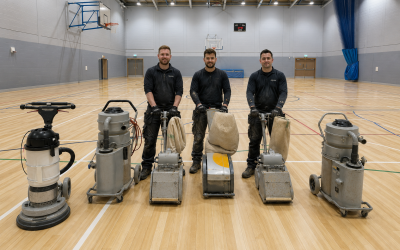
Because reception areas usually stay open to staff and visitors during the working day even when other parts of an office close for refurbishment, dust control matters more here than almost anywhere else in a commercial fit-out. Most office reception floor sanding in london projects we take on start life as exactly this kind of occupied-building job, which is why our sanding machines run on powerful extraction units throughout — capturing the vast majority of airborne dust rather than letting it settle on furniture, signage, and visitor seating nearby. The full detail on how the system works is on our dust-free floor sanding page. For herringbone, chevron, or basketweave parquet receptions, multi-directional sanding is required to handle the changing grain — our parquet floor sanding page covers that process in detail.

4. Finishing Options: Lacquer, Oil, Hardwax Oil, and 2K Systems
The right finish for a reception depends on how the space is used and how it needs to look. We talk this through during the survey rather than defaulting to one product:
- Water-based lacquer dries quickly (touch-dry in 2–3 hours), has low odour, and is the most practical choice for a reception that needs to stay usable. It’s available in matt through to gloss sheens to suit the corporate look of the space.
- 2K (two-component) lacquer, such as systems from Bona, is the most durable option available and is what we’d typically recommend for a flagship reception with very heavy footfall, since it gives the longest interval before the floor needs resanding again.
- Hardwax oil, including Osmo Polyx-Oil, suits period parquet and original boards where the goal is to keep a natural, breathable, matte look rather than a glossy sealed surface. It’s also straightforward to spot-repair if a small area gets damaged later.
- Natural oil finishes penetrate the timber rather than sitting on top of it, which works well where the original character of the wood — rather than a uniform corporate sheen — is the priority.
For larger or higher-spec commercial fit-outs, systems from Junckers are also widely used, particularly where solid timber flooring has been specified as part of the original build. Whatever’s chosen, every finish is applied in the correct number of coats with light abrasion between coats — skipping that step is the difference between a professional result and an uneven, patchy one. Full drying and recoat detail for each finish type is covered on our wood floor finishing page.
5. Aftercare and Ongoing Maintenance
A reception floor in continuous use needs a maintenance plan, not a one-off fix. Once the new finish is down, we provide a free floor care kit with the correct cleaner for that specific finish, plus practical advice: entrance matting to trap grit before it reaches the timber, felt pads under any furniture that does move, and avoiding generic supermarket floor cleaners, which dull most professional finishes faster than the foot traffic itself.
For managing agents and facilities teams looking after several floors or properties, a periodic screen-and-recoat — a light abrasion and a fresh top coat without sanding back to bare wood — extends the life of the finish considerably and is far less disruptive than waiting until a full resand is unavoidable. Our hardwood floor maintenance and care page covers what that involves and how often it’s typically needed.
Working Around Your Business
Closing a reception during normal trading hours usually isn’t realistic, so most of this work happens outside standard office hours: evenings from around 6pm, overnight, weekends, or bank holidays, with a confirmed written schedule agreed in advance. In larger multi-tenant buildings we phase the work to fit around other occupiers, lift bookings, and out-of-hours building access arrangements, and we’ll always confirm drying times before anyone walks across the floor again — typically 2–3 hours touch-dry for lacquer and 8–12 hours between coats for oil or hardwax oil, with full cure taking longer. We’ve applied the same approach to reception areas, lobbies, and front-of-house spaces in office buildings, members’ clubs, and mixed-use developments where the ground floor stays open to the public throughout. The same scheduling principles apply whether it’s a single-floor office or a building shared between several tenants — our commercial floor sanding page sets out how we structure that planning sector by sector.
Choosing an Office Reception Floor Sanding Contractor in London
If you’re comparing quotes, it’s worth asking a few direct questions of any office reception floor sanding contractor in london before booking: are they fully insured for commercial work, do they use genuine dust-extraction equipment rather than a standard belt sander, will they give you a written quote with no hidden extras, and can they recommend a finish based on your actual footfall rather than a one-size-fits-all answer?
A few things worth knowing about how we work:
- 30+ years of hands-on experience, including offices, schools, galleries, and hospitality venues across London.
- Professional, dust-controlled machinery from brands including Bona, Festool, Numatic, and Bosch.
- Fully insured for commercial premises, with documentation available on request.
- Premium finishing systems from Bona, Osmo, Junckers, Blanchon, and Morrells, recommended on durability and appearance rather than whichever happens to be in the van.
- A clear quote process — a free site survey, or an initial estimate from photos, video, and measurements sent via WhatsApp or email, with a written quote that matches what you actually pay.
- A free floor care kit included with every refinishing job, so the maintenance routine starts correctly from day one.

Office Reception Floor Restoration Cost in London
Costs depend on the floor’s condition, the size of the reception area, and the finish you choose. As a general guide:
| Service | Typical Cost |
|---|---|
| Sanding + 3 coats of lacquer | £22 – £30 per m² |
| Sanding + 2 coats of hardwax oil | £24 – £32 per m² |
| Sanding + staining + sealing | £28 – £38 per m² |
| Gap filling (resin or strips) | £4 – £8 per m² |
| Board or block repairs/replacement | £25 – £45 per m² per coat |
| Stairs sanding and finishing (feature staircases) | £60 – £90 per m² |
Smaller reception areas sometimes carry a slightly higher cost per square metre than a large open-plan floor, simply because preparation, edging, and finishing take a similar amount of time regardless of room size. A free site survey gives you an accurate, fixed written quote rather than a rough estimate — see our full floor sanding price guide for context across other floor types.
Frequently Asked Questions
Can you restore our reception floor without closing the building?
In most cases, yes. We typically work evenings, overnight, or weekends so the reception stays usable during normal trading hours, and we agree a written schedule before any work begins.
How long will the reception floor be out of action?
A standard reception floor sanding and finishing project usually takes 1–3 days, plus drying time before normal foot traffic resumes. We confirm exact timings, including cure time, during the survey.
Do you work with managing agents in multi-tenant buildings?
Yes. We regularly coordinate directly with managing agents, building security, and facilities teams on access, timing, and out-of-hours working in shared commercial buildings.
We found an old timber or parquet floor under our reception carpet — can it be restored?
Almost always. It’s one of the most common jobs we do in London offices. We assess block or board condition, repair anything loose or damaged, and sand and finish the floor to match the rest of the fit-out.
What’s the most durable finish for a busy reception?
For very high footfall, a commercial-grade 2K lacquer system gives the longest gap between resands. For period parquet where a more natural look matters, hardwax oil is usually the better fit — we’ll advise based on what we see during the survey.
How much does office reception floor sanding cost in London?
Most reception projects fall between £22–£38 per m² depending on the finish and the amount of repair needed, with gap filling and board replacement quoted separately. A free site survey gives you a fixed price.

Get a Fast Quote for Your Office Reception Floor
If your reception floor is looking tired, scuffed, or you’ve just uncovered original timber under old carpet, we’d be glad to take a look. Call us on 0800 955 0015 to talk it through, or send photos or a short video of the floor over WhatsApp or email for a fast, no-obligation estimate. For a fixed written quote, book a free site survey and we’ll work around your business hours from the very first visit.