School Hall Floor Is Slippery | Safe Timber Floor Restoration
If your school hall floor is slippery, it should never be ignored. Whether you manage a primary school in Westminster, an academy in Croydon, an independent school in Hampstead, or a church hall near Richmond, a polished timber floor that has lost its grip can quickly become a safety concern for pupils, staff and visitors.
At Sanding Wood Floors, we help schools across London identify why timber floors become slippery and recommend the most practical, cost-effective solution. In many cases, the problem isn’t simply age—it’s the build-up of unsuitable maintenance products, worn finishes, contamination, or a surface that has become excessively polished through years of heavy use. If your floor requires school hall wood floor maintenance in London or complete school hall floor sanding in London, our experienced team provides honest advice based on the condition of your floor rather than recommending unnecessary work.
Schools experience constant foot traffic, assemblies, PE lessons, performances, parents’ evenings and community events. These activities gradually wear protective coatings, making timber surfaces inconsistent underfoot. Our professional school hall floor sanding contractor in London service restores appearance while improving durability and helping provide a safer walking surface using modern commercial finishing systems.

Why Does a School Hall Floor Become Slippery?
Many people assume a shiny wooden floor is well protected, but excessive shine doesn’t necessarily mean better grip. In fact, some older varnishes, inappropriate cleaning chemicals and polish residues can create a smooth surface that becomes increasingly slippery, particularly when moisture is tracked into the building during wet weather.
Common causes include:
- Old varnish becoming smooth through years of wear
- Wax or polish residue building up over time
- Incorrect cleaning products
- Heavy foot traffic polishing the timber naturally
- Damaged or uneven lacquer coatings
- Dust, moisture or sports hall contamination
- Localised repairs using incompatible finishes
A professional inspection identifies the true cause before recommending maintenance, screening, recoating or complete restoration.
Our Professional Assessment Process
1. Initial Assessment and Planning
Every project starts with a detailed inspection of the timber floor. We assess the existing finish, measure wear patterns, identify slippery areas, check moisture levels where appropriate and examine previous repairs. We also discuss how the hall is used throughout the academic year to minimise disruption during restoration.
Many schools simply send photographs, videos and approximate measurements for an initial quotation. Larger halls or more complex projects may benefit from a site visit before work is scheduled.
2. Repairs, Board Replacement and Gap Filling
Before sanding begins, any structural issues should be resolved. Loose parquet blocks, damaged floorboards, lifted sections and worn expansion gaps are repaired using matching timber wherever practical.
Typical repairs include:
- Replacing damaged hardwood boards
- Securing loose parquet blocks
- Repairing movement in older floors
- Gap filling where appropriate
- Removing trip hazards
- Levelling isolated uneven areas
Good preparation ensures the finished floor performs properly for many years.
3. Dust-Controlled Sanding and Surface Preparation
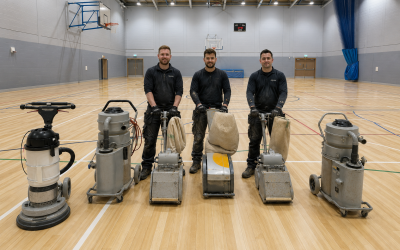
Modern commercial sanding equipment removes worn finishes evenly while capturing the vast majority of dust. Progressive sanding stages eliminate scratches, old coatings, surface contamination and uneven wear without damaging the timber unnecessarily.
During preparation we carefully:
- Remove old lacquer and polish residues
- Eliminate surface scratches
- Reduce staining where possible
- Smooth repairs
- Prepare edges and corners
- Create an even surface for finishing
Our dust-controlled machinery helps minimise disruption and keeps adjoining classrooms and communal areas considerably cleaner than traditional sanding equipment. Modern commercial sanding systems and preparation methods are recognised throughout the flooring industry for improving finish quality and reducing airborne dust during restoration. Bona provides further information on professional floor finishing systems.

4. Commercial Finishing Options
Choosing the correct finish is one of the most important decisions for a busy school hall. The right product depends on footfall, cleaning routines, sporting activities and expected maintenance intervals.
Popular options include:
- Water-based commercial lacquer
- Hardwax oil systems
- Traditional penetrating oils
- Two-component (2K) commercial finishes
- Low sheen finishes for practical maintenance
- High durability sports hall coatings where appropriate
We regularly specify professional systems from recognised manufacturers including Loba, Osmo UK and Junckers, selecting products according to how the hall is actually used rather than simply choosing the most expensive option.

5. Aftercare and Ongoing Maintenance
The best way to prevent a school hall floor becoming slippery again is through planned maintenance rather than waiting until the finish completely fails.
We provide guidance covering:
- Recommended cleaning products
- Routine maintenance schedules
- Entrance matting improvements
- Furniture protection
- Sports equipment management
- Periodic inspections
- Future recoating before major wear develops
Preventative maintenance is usually far more economical than repeated full restorations.
Working Around the School Calendar
We understand that educational buildings cannot simply close for refurbishment. Wherever possible, projects are planned during school holidays, half-term breaks, weekends or other agreed periods to minimise disruption.
For larger London schools, phased working can allow different sections of the building to remain operational while restoration progresses safely.
Frequently Asked Questions About Slippery School Hall Floors in London
1. Why has our school hall floor become slippery?
School hall floors often become slippery because the original protective finish has worn unevenly, cleaning products have left a residue, or the surface has been polished repeatedly through heavy foot traffic. Moisture brought in during wet weather and years of assemblies, sports and community events can also reduce grip. A professional inspection can identify the exact cause before recommending the most suitable solution.
2. Can a slippery timber floor be made safe without replacing it?
In most cases, yes. Complete replacement is rarely necessary. Depending on the condition of the timber, the floor may simply require a deep clean, maintenance coat, screen and recoat, or full sanding and refinishing. Repairs are usually limited to damaged boards or loose parquet sections.
3. Is sanding always necessary for a slippery school hall floor?
Not always. If the existing finish is still in reasonable condition, a maintenance recoat may be enough. However, if the lacquer has worn through, become uneven or contaminated with old polish, professional sanding is generally the best way to restore both appearance and performance.
4. How long does school hall floor restoration usually take?
The timeframe depends on the size and condition of the hall. Many school hall floors can be completed within a few days, while larger sports halls or heritage buildings may take longer. Projects are often scheduled during school holidays, weekends or half-term breaks to minimise disruption.
5. Will there be a lot of dust during floor sanding?
Modern commercial floor sanding uses advanced dust-controlled machinery that captures the vast majority of sanding dust. While no system is completely dust free, today’s professional equipment keeps airborne dust to a minimum compared with older sanding methods.
6. Which finish is best for a busy school hall?
The best finish depends on how the hall is used. Commercial water-based lacquers are popular because they offer excellent durability and are easy to maintain. Hardwax oils and specialist two-component (2K) finishes may also be recommended where appropriate. Your contractor should advise on the most suitable product for your school’s daily activities.
7. Can damaged floorboards and loose parquet blocks be repaired?
Yes. Before sanding begins, damaged timber, loose parquet blocks and unstable floorboards should be repaired or replaced where necessary. Completing these repairs first helps create a safe, durable floor with a consistent finish.
8. How can we stop our school hall floor becoming slippery again?
Regular maintenance is the key. Using the correct cleaning products, protecting entrances with quality mats, avoiding unsuitable floor polishes and arranging periodic maintenance inspections can significantly extend the life of the finish and reduce the risk of slippery surfaces.
9. Do you work around school term dates?
Yes. Professional contractors understand the importance of avoiding disruption to lessons and school activities. Most restoration work is scheduled during summer holidays, half-term breaks, weekends or other agreed periods when the hall is not in regular use.
10. How can we get a quotation for our school hall floor?
The quickest way is to provide photographs, approximate measurements and a short video showing the condition of the floor. For larger or more complex projects, a site visit may be recommended before preparing a detailed quotation. This allows the contractor to assess repairs, finishing options and the most practical schedule for the work.

Why Schools Across London Choose Our Team
- More than 25 years of practical timber floor restoration experience
- Specialists in commercial and educational buildings
- Dust-controlled sanding equipment
- Safe working practices
- Professional commercial-grade finishing systems
- Honest recommendations based on floor condition
- Flexible scheduling around school terms
- Clear quotations with no unnecessary work
- Support before, during and after restoration
Request a Free Assessment
If your school hall floor has become slippery, don’t wait until someone suffers a preventable accident. We can assess the condition of your timber flooring, explain the available restoration options and provide a clear quotation without obligation.
Call 0800 955 0015 today or send photographs, measurements and a short video of the floor through our website for an initial assessment. Where necessary, we can arrange a site visit anywhere across London to recommend the safest and most practical solution.

Read our recent blogs
What you should do next